Beleaguered KPFK Workers Need Support in Election; Union Member Says, “Vote UCR”

BY ANTHONY FESTvote-661888_1280

NOVEMBER 30, 2015: KPFA subscribers have five more days to vote in the election for KPFA’s governing body, the Local Station Board.
 

Meanwhile, the National Labor Relations Board (NLRB) is hearing multiple grievances from unionized staff members at KPFA’s Southern California sister station KPFK, grievances prompted by the actions of KPFK’s recently-appointed manager. The KPFK workers say management has violated their union contract, cut their hours, and failed to pay thousands of dollars in pension contributions and union dues.

Is there a connection?
Indeed there is, and KPFA voters should take heed:
Leslie Radford, the KPFK general manager responsible for the workers’ grievances and the widespread listener complaints, was appointed by none other than KPFA board member Margy Wilkinson. And Wilkinson is now running for re-election to the KPFA board.

What’s Going On?
KPFA and KPFK are two members of the five-station Pacifica Foundation network. Each of the five stations elects a Local Station Board; then the five local boards each send four members to the Pacifica National Board (PNB), the legal “board of directors” of Pacifica. The network and its stations are supposed to be overseen by a full-time Executive Director, hired by the PNB, but the current PNB seems unable to keep an ED on the job; two have departed after short stints in the post. In the absence of an ED, the Chair of the PNB is acting ED. It was in that role that PNB Chair Margy Wilkinson appointed Radford as manager of KPFK this past June. Incredibly, Wilkinson installed Radford in the KPFK job one day before a newly-hired ED began work. Evidently, Wilkinson didn’t want to leave the hiring of a station manager in the hands of someone with actual radio experience. And Radford’s apparent qualification for the general-manager job was being a member of the KPFK board faction that’s allied with Wilkinson’s “Save KPFA.”

In only four months on the job, Radford has so alienated KPFK workers and listeners that a no-confidence petition on Change.org has garnered 250 signatures. The signatories include listeners, present and former KPFK staff, former KPFA staff members Esther Manilla and John Hamilton, and Uprising host Sonali Kolhatkar, whose program is heard on both stations. The no-confidence statement cites labor-contract violations, fundraising blunders, “disastrous programming decisions,” and other problems. It concludes, “ We believe Radford is a liability to KPFK and will lead the station to bankruptcy and/or numerous lawsuits until KPFK is no more.”
 
Some of the KPFK staff members have also created a Facebook page to publicize their issues; Facebook users can find it here.

Throw the Bum(s) Out?
Under Pacifica’s bylaws, the KPFK LSB could begin the process of firing Radford, although the ultimate authority is the Pacifica National Board. This month’s election could swing the balance of power on the local boards and thus the National Board. Therefore, KPFA voters should consider this advice from long-time KPFK staffer and union member Ali Lexa:

As a current SAG-AFTRA member, I can tell you the union busting at KPFK going on right now is real, and Margy Wilkinson is no friend of our union. If we don’t get the Pacifica National Board into better hands immediately, our station in LA which is the biggest non-commercial radio signal west of the Mississippi River and the most important free speech voice in Southern California, is done. So please vote UCR. It’s the pro-labor vote.

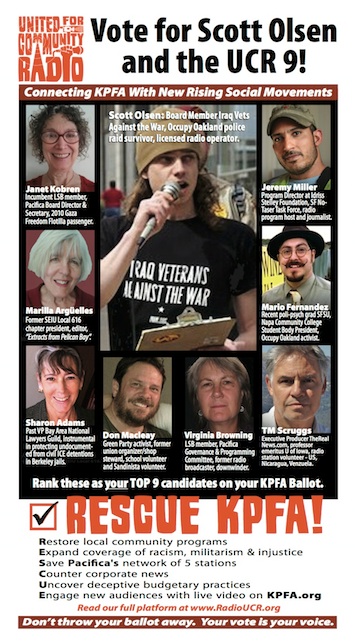
United-for-Community-Radio (UCR) is supporting a well-qualified team of nine candidates for the nine KPFA LSB seats to be filled by KPFA subscriber votes. The UCR team includes a union leader for home care workers (Marilla Argüelles), and a former organizer and shop steward (Don Macleay); they’re part of a diverse group of individuals advocating for peace and social justice.
 

To support both KPFA and KPFK, please vote for the nine UCR candidates! To be sure of meeting the voting deadline of Friday, December 4, KPFA subscribers should vote online using the access codes that came with their paper ballots.
PAST: United For Community Radio Postcard 2015

pc_photos


United for Community Radio Candidates.


Make Your Voice Heard

Vote in the KPFA Local Station Board election!!!


Paper ballots have been mailed, so if you haven’t received one, please contact the KPFA election supervisor,  kpfa-les (at) pacifica.org


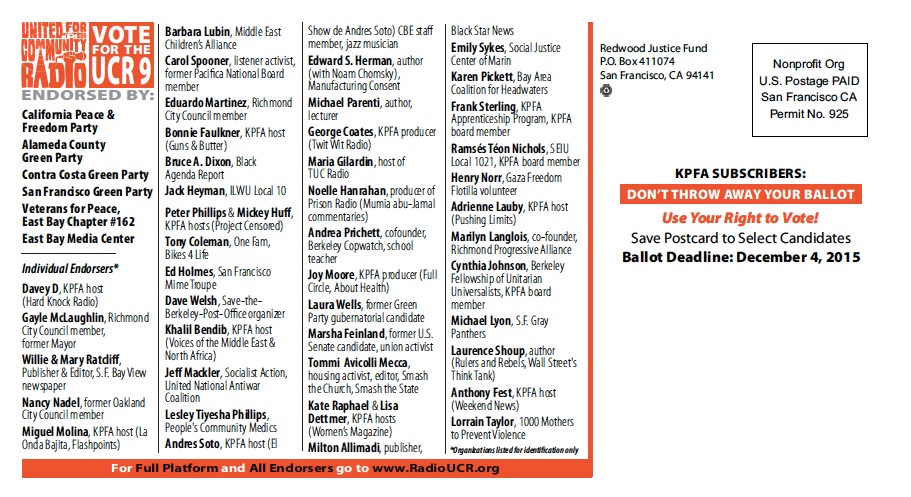
Some of the many endorsers of UCR Candidates:  postcard2

Pacifica National Board Already Decided — Bequest Should Have Been Sent to Pacifica!

By:  UCR Candidate Sharon Adams

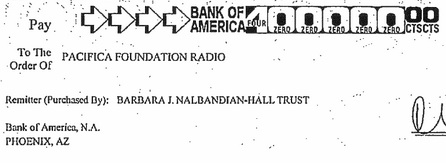
Our opponents have been claiming that United For Community Radio “cost KPFA $400,000“, implying that KPFA was actually entitled to a $400,000 bequest.  Of course, that is the exact issue — KPFA was not entitled to the $400,000 bequest — the Pacifica Foundation was entitled to this bequest.  Our opponents inappropriately decided, WITHOUT CONSULTING PACIFICA, that this bequest was intended solely for KPFA.  The reason we know that KPFA was not entitled to the $400,000 bequest is because the Pacifica National Board (PNB) has determined that the bequest was actually supposed to go to Pacifica.
Bequest_Check

The PNB’s decision is supported by the evidence.  First and foremost, both the bequest and the check were specifically made out to “Pacifica Foundation Radio”.  There was no mention of KPFA in the bequest documents.

Pacifica LogoAnd, even assuming there was ambiguity in the identification of Pacifica Foundation Radio, the proper response would have been to contact the PNB to mutually discuss and decide how to deal with the bequest.  It was our opponents failure to ask Pacifica that is at the heart of this matter.   To the extent that our opponents felt there *was* ambiguity, they should have checked with the Pacifica National Board.

Interim Executive Director (and SaveKPFA candidate) Margy Wilkinson later apologized for this failure to disclose — after the fact and when the bequest funds were already comfortably residing in the KPFA bank account.  It really would not have been that difficult to send this information to Pacifica prior to depositing the check in the KPFA bank account.

FBOKPFA

~Screen shot of kpfa.org website

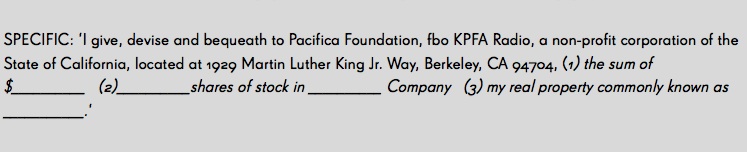
As the image above shows, it is quite easy to make a bequest that is for KPFA, and the KPFA website provides clear instructions on how to do this.  Of course, Pacifica must be mentioned in the bequest instructions because Pacifica is the parent organization of KPFA.  Significantly, the KPFA website makes clear that the phrase “for the benefit of KPFA” or “fbo KPFA” must be added.  This is not difficult to do, and is standard operating procedure for attorneys working in estate planning who are trained to make clear and unambiguous bequests.

Now that our opponents have been exposed, they start the mudslinging, with personal attacks on UCR candidate Janet Kobren who found the documents showing that the bequest was intended for the Pacifica Foundation.  However, Janet Kobren was simply doing her duty as a board member and secretary of the PNB.  This is in stark contrast to other KPFA members on the PNB, Brian Edwards-Tieckert and Margy Wilkinson.  They have shown that they are willing to “Save” KPFA — at the expense of the entire Pacifica network.

United for Community Radio is not into assigning blame.  UCR wants to ensure that the entire Pacifica network remains strong, including KPFA and its sister stations.  UCR’s opponents must stop cannibalizing Pacifica to allegedly “Save” KPFA.

Vote for the entire UCR slate in the KPFA Local Station Board election.

RESCUE KPFA from Save KPFA

gears-820980_640

For another perspective on the bequest, read Frank Sterling’s article here about how We Are All One!
Frank Sterling is KPFA’s Technical Director of First Voice Media program.


Joe Hill’s Last Will, 100 Years Later

Joe Hill 3by Bob English

I dreamed I saw Joe Hill last night,
Alive as you or me …

Swedish-American labor organizer, poet and songwriter Joe Hill was executed 100 years ago on Nov 19, 1915. Born Joel Emmanuel Hagglund, Oct 7, 1879, he emigrated to the US in 1902. Working on the West Coast as a migrant laborer in 1910, he joined the Industrial Workers of the World (IWW), the “Wobblies,” a radical union of immigrants (subjected to the anti-immigrant hysteria of that period), founded on the principle of One Big Industrial Union for all workers. 

Traveling widely and organizing workers under the IWW, Joe Hill was wildly popular and visible as a speaker, writer of satirical poems, political and union songs (based on tunes of the times), which he performed at IWW strikes and rallies.

Would you have freedom from Wage slavery
Would you from mis’ry and hunger be free…

Come, all ye workers, from every land,
Come, join in the grand industrial band;
Then we our share of this earth shall demand…

(Rousing Chorus)

There is pow’r, there is pow’r in a band of workingmen,
When they stand, hand in hand,
That’s a pow’r, that’s a pow’r
That must rule in every land—
One Industrial Union Grand!

“There is Power in a Union” 1913 by Joe Hill

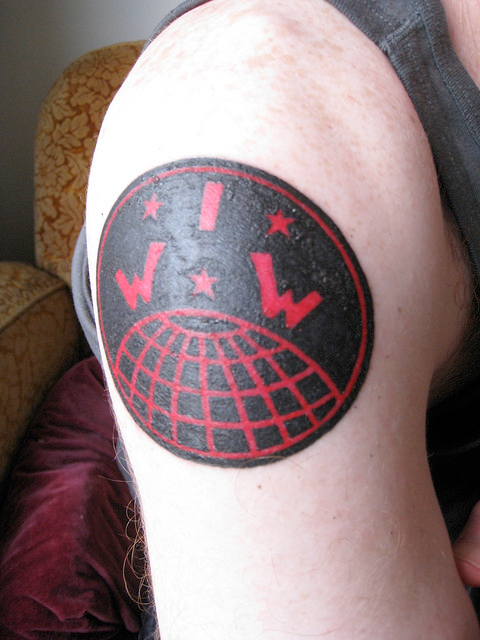
IWW tattoo

IWW tattoo

This year Joe Hill’s life, last hours and legacy to the labor movement and folk music are honored and narrated in a performance and album of his songs, Joe Hill’s Last Will by singer/songwriter John McCutcheon.   The stage play, written by Si Kahn, was first performed in Sebastopol, California 2011.

“Hill channeled his experiences into songs, the first written for the American working class. Those songs helped galvanize the union movement, specifically the IWW, whose activism triggered violent opposition from the wealthy class we now refer to as the ‘1 percent’” (from the show announcement).

As such, he was targeted by the 1% capitalists, particularly the “copper bosses” of Silver King mine, Park City Utah where he was arrested for murder in 1914, framed and convicted. The unjust trial and capital punishment sentence were challenged by a prominent clemency campaign and generated international media attention, union and public protest. In the stage narration of his last hours in jail before his execution at dawn, Hill thought few would remember his life and work.

(Written in his cell, on the eve of his execution)

My will is easy to decide,
For there is nothing to divide.
My kind don’t need to fuss and moan —
“Moss does not cling to a rolling stone.”

My body? Ah, if I could choose,
I would to ashes it reduce,
And let the merry breezes blow
My dust to where some flowers grow.

Perhaps some fading flower then
Would come to life and bloom again.
This is my last and final will.
Good luck to all of you.

“Joe Hill’s Last Will” (lyrics by Joe Hill, music by John McCutcheon)

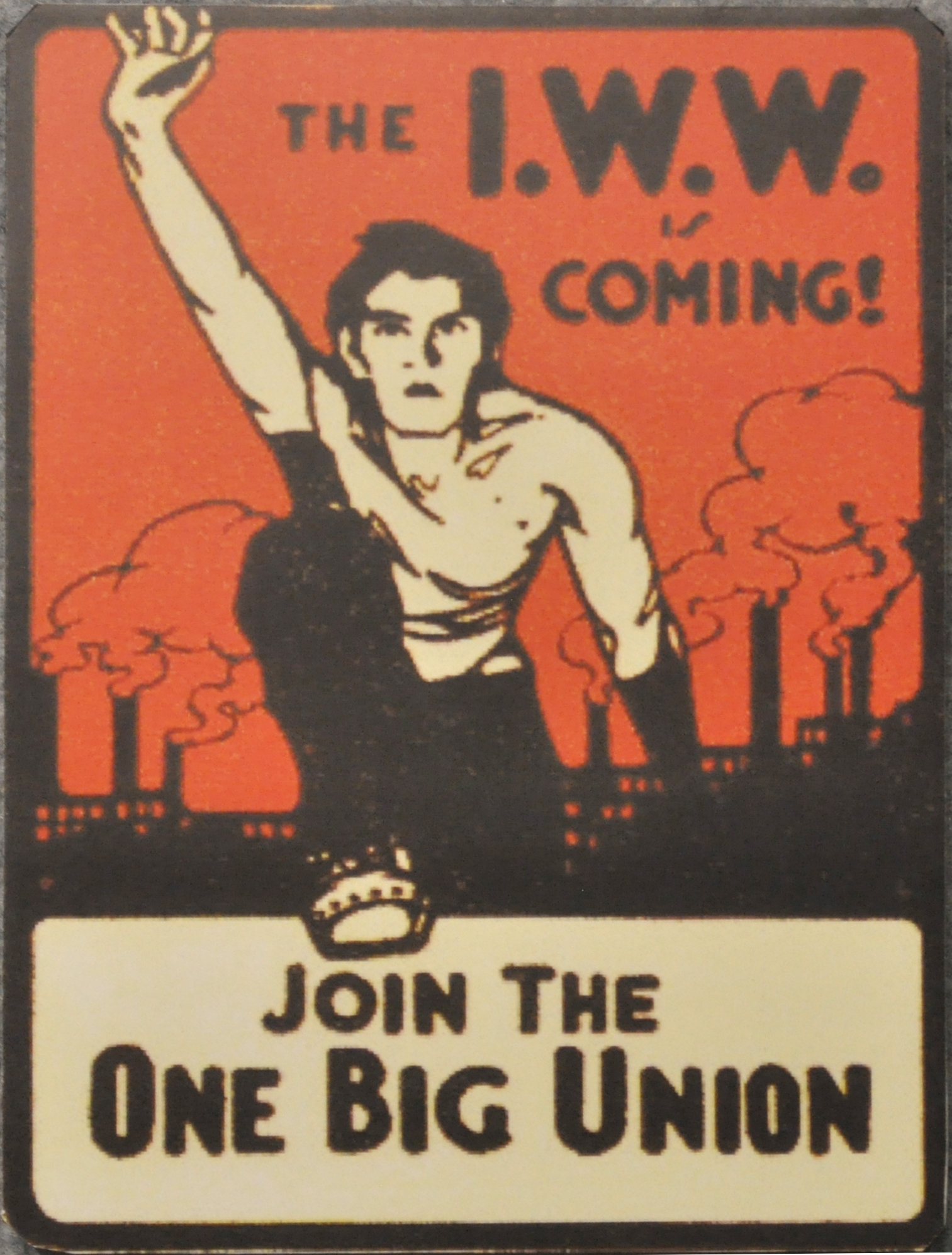
IWW sticker, 1910s, courtesy Wikipedia

IWW sticker, 1910s, courtesy Wikipedia

100 years later Joe Hill is one of, if not the most renowned, beloved and inspiring labor leaders of the 20th century. In this century, he stands Presente! with farm workers and the lowest paid, marginalized, unorganized workers; rank and file members fighting for democratic unions, today’s still militant IWW and International Longshore and Warehouse Union (ILWU).

In October 1960 in Sydney, Australia, the great Paul Robeson performed a powerful rendition of “Joe Hill” to construction workers at the site of the future Sydney Opera House.


Says I, “But Joe, you’re 100 [ten] years dead,”
“I never died,” says he.

And standing there as big as life
And smiling with his eyes
Says Joe, “What they forgot to kill
Went on to organize.

Where working people [men] are out on strike
Joe Hill is at their side

From San Diego up to Maine,
In every mine and mill –
Where working people [men] defend their rights

It’s there you’ll find Joe Hill.

I dreamed I saw Joe Hill last night,
Alive as you or me
Says I, “But Joe, you’re 100 [ten] years dead”,
“I never died,” says he.

“Joe Hill” 1930 by Alfred Hayes [updated for centenary]

Through his progressive songwriting a century ago, Joe Hill articulated and transmitted still current issues of immigrant and workers rights, economic and class inequality, feminism, religion and war. “Casey Jones–The Union Scab,” “The Preacher and the Slave,” “The Tramp,” “The Rebel Girl” and “There is Power in a Union” are folk and union standards.

Critically, Joe Hill inspired the great Woody Guthrie, a primary influence for modern singer/songwriters, including Bob Dylan, Pete Seeger, Huddie Ledbetter (Leadbelly), Phil Ochs, Billy Bragg, ani difranco – and Utah Phillips, who (before McCutcheon) had reintroduced Hill and his music. Their recordings, progressive commentary and connection to Joe Hill are featured in music programs on community radio KPFA 94.1 FM, especially Robbie Osman’s “Across the Great Divide,” now hosted by Kevin Vance Sunday mornings.

Further, the IWW/Joe Hill industrial union model, objectives and vision are central to understanding current issues, dynamics and effectiveness of labor organizing, after a long period of steadily declining, sporadically resurgent union membership and power. As we learn from John McCutcheon’s performance, Joe Hill and IWW regarded exclusive craft/trade unions as self-serving job trusts, often acting as “scab” unions. They would have a similar assessment of the larger, growing but often management friendly, hierarchical, bureaucratic, staff-run business unions  representing service workers and public employees, notably Service Workers International (SEIU).

Currently, there are struggles throughout the labor movement (e.g. National Union of Healthcare Workers defection from SEIU/United Healthcare Workers) for more democratic, “member driven,” inclusive unions, fighting for the interests and benefits of all workers, ready to take on (not accommodate, deal or collaborate with) management, the corporate-governmental complex, political machines and power structures.

These differences and conflicts between industrial and craft or business unions, their effects in terms of representing, including or excluding workers, are analyzed in an upcoming, related article, reviewing recent history and politics of Pacifica-KPFA community radio unions, a complex, controversial and well-documented subject.

———————-

Bob English, from a working class, union family; retired civil service worker, labor democracy activist formerly with SEIU L790 and Public Employees for a Democratic Union; community radio activist formerly with listener groups Coalition for a democratic Pacifica and Peoples Radio.

———————-

Thanks to Eszter Freeman, Attila Nagy (Sonoma Peace Press), Adrienne Lauby (UCR website), Isis Feral and Stan Woods for review/suggestions, editing, images, production; my son Austin and wife Linda Hewitt for review, encouragement and support completing the work;  John McCutcheon, and Dr. Barbara Hodges for inviting us to his inspiring performance of “Joe Hill’s Last Will” at the Palms Playhouse in Winters, California, June 5, 2015.

———————-

Graphics:
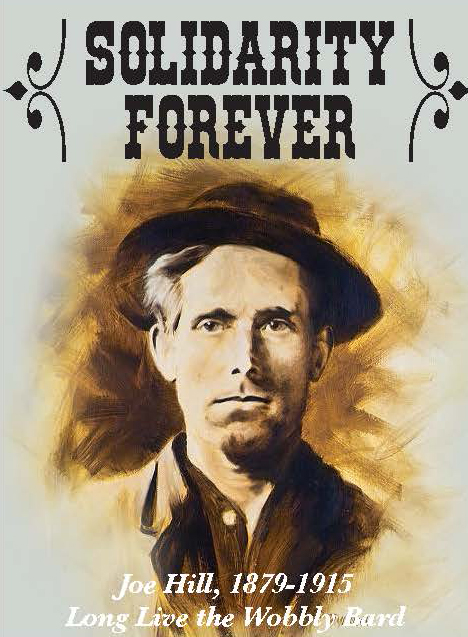
Joe Hill Poster
IWW Tattoo by vonlampard license
IWW sticker 191os


On-Air Candidate Forums

https://www.flickr.com/photos/audiolucistore/11046790073

From Flickr, license below.

One-Hour Live
Listener Candidate Forums

KPFA Performance Studio
19 Candidates, 4 Forums

(Click on the dates, to listen)

Sharon Adams
Brian Oakchunas
Scott Olsen
 
Don Macleay
Barbara Whipperman
T.M. Scruggs
Margy Wilkinson
Marilla Arguelles


Yuri Gottesman
Janet Kobren
William Campisi
Mario Fernandez 
Jeremy Miller


Tom Voorhees
David Lynch
Virginia Browning
Sasha Futran


Moderator/Host:

Nelsy Batista, Local Election Supervisor
Substitute Moderator, Leon from Youth Radio/Bay Area MC

 Three or four of the questions asked came from the studio audience.  The names of those asking the question were pulled from a hat.

————

These candidates were scheduled but did not appear:
Richard Hart
Leland Thompson


Graphic: license

Beholden to Nobody but the Listeners

By: Susan da Silva

To me the most important plank of the United for Community Radio (UCR) platform is the one that will preserve Pacifica as an independent entity where free speech is valued.  I’m referring to this part of the platform: Refuse corporate underwriting or advertising.  

These are desperate times at Pacifica.  Many people say: “There simply is not enough money, so why not take advertisements?”   The answer is that taking corporate money will change Pacifica and KPFA in ways that are unacceptable. 

Keep Corporations Out of Our Daily Life - photo credit below

Keep Corporations Out of Our Daily Life – photo credit below

At this point, at most Pacifica stations, there is no outside entity beyond the FCC who has any say about what is on the air.  Sometimes what goes out is not polished, sometimes it’s not politically correct, sometimes it causes us to protest. All that is good in my opinion.  That’s what makes us trustworthy.  We are accountable to each other and to the listeners, no one else.  Each person who speaks, speaks for themselves. With corporate underwriting would come outright censorship and self-censorship.  We might as well be NPR! Those who say that they never feel pressured by their advertisers, are not being totally honest, in my opinion.  They don’t even realize that they are self-censoring.

In this world ruled by corporations, Pacifica is a unique network, a place where no outside corporation can tell us what to say or feel or think.

Bring The People In - photo credit below

Connect with the People – photo credit below

So how do we get the money we need?  We do it with programming that connects to many parts of the community, programming listeners really want.  We do it by bringing new voices to the air.  We do it by reminding the listeners that we don’t take corporate money, and that we listen to them and allow them to vote for board members. We do it by being fiscally responsible enough to not leave millions of CPB dollars on the table.  (Pacifica has not received CPB money for several years because of their inability to complete an audit.)

Somewhere along the line Pacifica stopped taking budgets and audits seriously.  That nonchalance has brought us to the brink of losing our network.  I believe that hard fiscal decisions need to be made immediately.  I believe that once we get our financial house in order, we can go forth with the support of the listeners and that we will not need corporate funds to do so.

If you don’t want corporate underwriting and advertising on your Pacifica station, please vote for the UCR candidates.

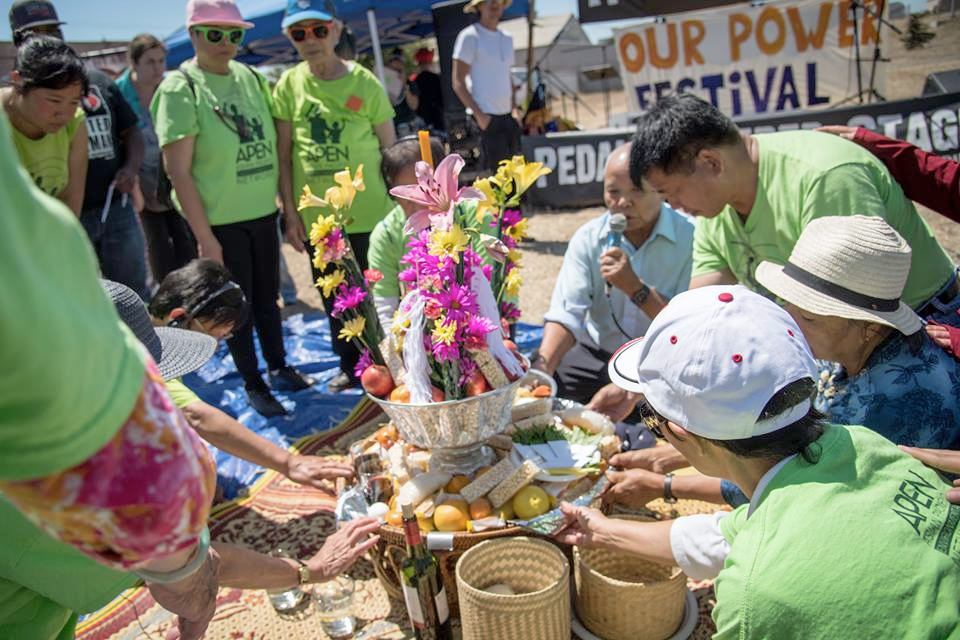
“Keep Corporations Out of Our Daily Life.” – photo by Brooke Anderson from “Our Power Festival” in Richmond, CA.

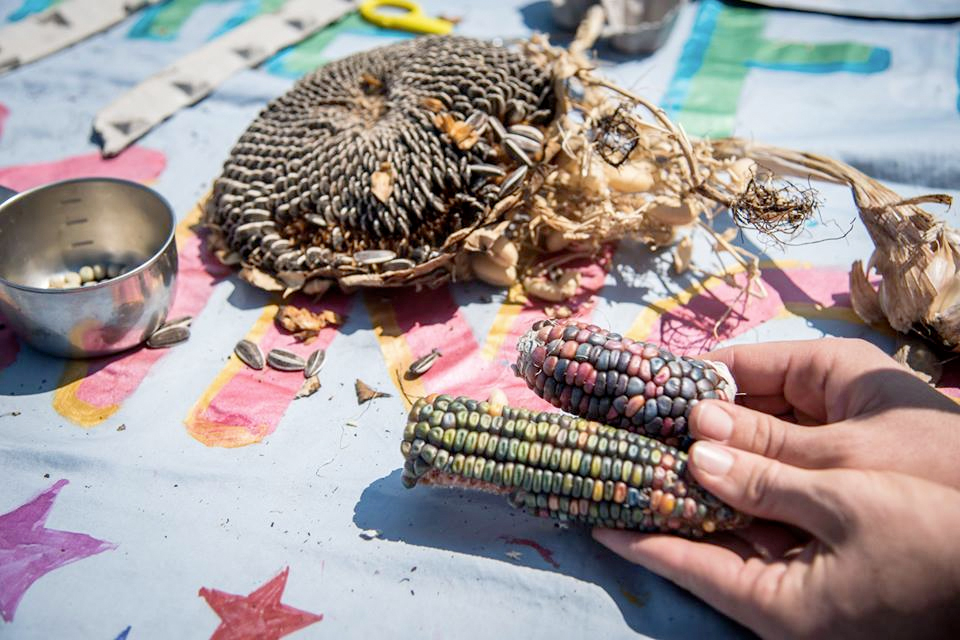
“Connect with the People.” photo by Brooke Anderson from “Our Power Festival” in Richmond, CA.