Chevron, the Richmond City Council and the Morning Mix

Chevron’s freedom to pollute vs. Bay Area residents’ right to breath

by Daniel Borgström
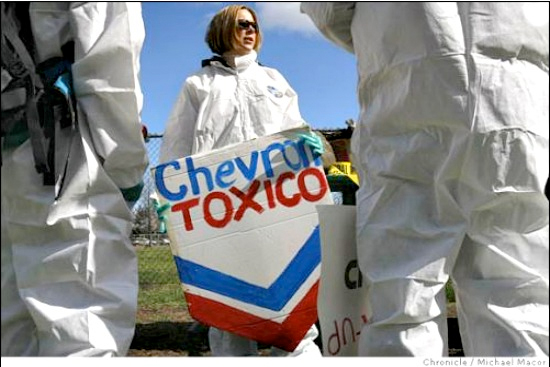
Chevron ToxicoOn Tuesday, July 29th, I went to the Richmond City Council meeting where the council was to make a decision on a proposed expansion of the Chevron Refinery. The City Planning Commission approved the expansion, but with conditions that Chevron didn’t want to accept. So Chevron appealed it to the City Council.

It was held in the large Richmond Auditorium to accommodate an expected crowd of Bay Area residents (and paid-by-Chevron speakers), 15,000 of whom were sent to the hospital following the huge refinery explosion in 2012. Chevron mobilized several hundred employees to attend the meeting, wearing blue and white pullover shirts, and waving signs saying “A Modernized Refinery” and “Richmond Proud” — slogans from Chevron’s PR campaign. The blue & white shirts made their supporters very visible, and at first it appeared that they overwhelmingly outnumbered people of the Richmond Progressive Alliance (RPA).

The RPA was indeed outnumbered, but not as badly as it had at first appeared. Judging from the amount of applause that speakers from each side received, I could tell that there were a sizable number of people there to support the RPA or who supported their position.

For the past two decades, the RPA has been standing up to Chevron, which has always dominated Richmond. At this hearing the RPA called for the City Council to affirm the Planning Commission’s conditions to impose environmental standards and limit pollution.

There were about 80 speakers. A friend and I stayed only for the first two hours. Most of the speakers during this time expressed concern about air quality and health problems; these included Asian community members who had been hospitalized as a result of inhaling toxic fumes during the refinery fire. Some of the refinery’s critics wore signs saying: “I’m not paid to be here.” — that was in reference to reports that Chevron supporters at the previous meeting had been paid to attend. A reporter from KPFA found a woman with a clipboard checking off names of Chevron’s acolytes. The clipboard lady of the previous week was also at this meeting. Another KPFA reporter got a photo of her.

The people sitting around us included people from both sides. Interestingly, several times I noticed some of the people in blue and white applauding speakers who pointed out the environmental hazards created by the refinery. That surprised me; I didn’t know what to make of it, or what it might imply.
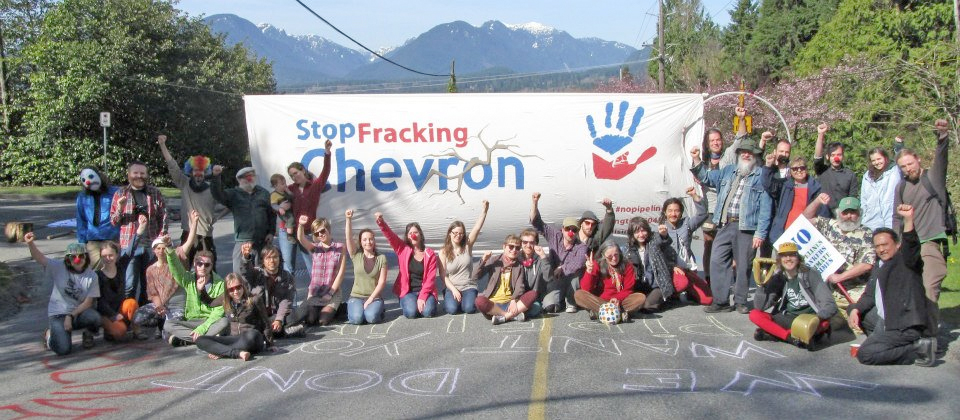
Canadian activists block highway to Chevron refinery to protest Chevron’s participation in the Pacific Trail Pipeline and the destructive gas fracking it proposes using to supply the pipeline to the coast.

Canadian activists block highway to Chevron refinery to protest Chevron’s participation in the Pacific Trail Pipeline and the destructive gas fracking it proposes using to supply the pipeline to the coast.

We left at about 8:30 p.m., before the city council made its decision. Afterwards I heard the news, that the council acceded to Chevron’s demands. Mayor Gayle McLaughlin and Vice Mayor Jovanka Beckles abstained over the failure to fund the hospital which had treated people during the 2012 Chevron fire.

Richmond has been a company town throughout its existence. First it was a Standard Oil town. When Standard Oil was broken up, it became a Chevron town. During the 1980s and 90s it spread less money around, probably because of corporate tax breaks making it less tax wise, and that made an opening for the RPA. When the RPA made gains and Chevron realized they’d lost control, Chevron began a campaign which included spreading money around as part of a “community benefits” agreement — one way that Chevron gets nonprofits on their side.

It left me wondering if Chevron might’ve also invested some of its PR budget money in KPFA, encouraging the clique who run the station to take Andrés Soto off prime time. Andrés had been a very effective show host of KPFA’s Morning Mix; and an RPA activist with Communities for a Better Environment. He often focused on news about the Richmond refinery and its environmental effects — the 2012 refinery explosion and resulting pollution which sent 15,000 people to hospitals, as well as the hazards of the dirty crude which was being brought into the town in railroad tank-cars. He was also tuned into Chevron’s affect on Richmond politics and talked about who is in Chevron’s pocket. Andrés Soto’s show is hardly something that Chevron would care to have broadcast across Richmond as they try to reclaim it as the company town it was before the rise of the RPA

Ann Garrison and Steve Gilmartin contributed to this article.

To read more from Daniel Borgstrom:
http://danielborgstrom.blogspot.com/

Andrés Soto’s program, now titled “Afternoon” can be heard from 3:30-4 pm on Thursdays at KPFA, 94.1 fm, or streaming at kpfa.org.  His program was cut in half and given a more obscure time slot when the Morning Mix was taken off the air..


KPFA’s Andres Soto at the San Francisco Labor Council


Communities for a Better Environment Richmond campaign coordinator and KPFA host Andres Soto speaks at the San Francisco Labor Council about the programming he and his Morning Mix colleagues were creating for KPFA and Pacifica on July 14, 2014.

Green Party of Alameda County Signs on to SF Green Party Statement to “Report Locally”


images


The Green Party of Alameda joins the San Francisco Labor Councilthe Gray Panthers,ILWU Local 10East Bay Veterans for Peace,Sonoma County Veterans for PeaceILWU Local 10the Harvey Milk LGBT Democratic Club, the Richmond Progressive Alliance, the San Francisco Green Party and the Golden Gate Letter Carriers in calling for restoration of the KPFA Morning Mix to its 8 am weekday hour.

“Think globally, act locally” is as relevant today as it was in 1915, when Scots biologist, sociologist, and town planner Patrick Geddes wrote Cities in Evolution.  “We need locally produced, locally relevant programming to help us make specific connections between our daily lives and politics and those of the international community and the planet.”

We find it difficult to understand why you replaced The Morning Mix with syndicated programming produced in Los Angeles, because locally produced programming about politics, art, culture, and the environment in a station’s fm signal area is the heart of community radio. We need to understand the realpolitik immediately around us, in the San Francisco Bay Area, not just in Iraq, the Ukraine, Nigeria, Los Angeles, or the distant chambers of Washington D.C. or the United Nations.

In the San Francisco Bay Area, the movement towards community-based and/or regional renewable power infrastructure has reached a critical stage. We need to understand every step forward or backwards as this story unfolds on the ground, in our City Council and County Board of Supervisors offices, in public agencies and at public gatherings. San Franciscans need to know what is happening in the City of Richmond, in Marin, Sonoma, and Napa Counties, and in East Bay and South Bay counties where citizens are attempting create renewable energy infrastructure.

Despite a California State mandate to produce at least 20% renewable power by 2010, PG&E is still producing only 19%, four years later, and doing whatever it can to stop Bay Area communities from creating clean energy buyers’ co-ops, or banding together as one and eliminating its dirty energy monopoly. PG&E strategists may have been most successful at the San Francisco Public Utilities Commission, where they have used the San Francisco Mayor’s office – which they traditionally control – to block the implementation of our renewable power plan Clean EnergySF for two years, even after the San Francisco Board of Supervisors unanimous vote for it.

PG&E has also been able to activate its union, the International Brotherhood of Electrical Workers 1245, to oppose CleanPowerSF; this calls for the attention of a local labor reporter like Morning Mix host Steve Seltzer.

Uprising host Sonali Kolhatkar lives within Southern California Edison’s monopoly and cannot possibly cover this as our local hosts can. We need diverse voices of hosts and reporters in touch with those on the ground, not the lone voice of Brian Edwards-Tiekert and/or his pinch hitter, Marie Choi, much as we appreciate the addition of Marie’s voice to the morning hours.

This is not a “narrowly focused, local issue,” as KPFA Interim General Manager Richard Pirodsky suggested the Morning Mix hosts had typically covered. in his parting lecture to the KPFA Local Station Board. We’re thinking globally and acting locally, for the survival of the planet and a sustainable peace rather than never-ending dirty energy wars. The same can be said of efforts to create municipal and regional mass transportation networks,local agriculture, just criminal justice, and other central elements of sustainable culture.

Every municipality in the Bay Area struggles with criminal justice issues including racial profiling, police brutality, police accountability, whether or not to arm police officers with tasers, whether to allow stop’n frisk, whether to allow Police Departments to report juveniles to immigration authorities, and police shootings of minority youth like Oscar Grant, Alan Blueford, Alex Nieto, and Andy Lopez. These police issues are all part of a national discussion, but local decisions determining how they play out here are made at multiple local levels every day. .

What does an LA or New York broadcast host know about the San Francisco Re-entry Council, which created a model for re-integrating ex-offenders that is now studied nationally? What do they know about former San Francisco Sheriff Mike Hennessey, current Sheriff Ross Mirkarimi, and Public Defender Jeff Adachi’s groundbreaking work in rehabilitation and re-entry?

How much can they know about Oakland’s infamous police corruption or the Oakland Domain Surveillance Center proposed barely a year after Occupy Oakland grabbed the national and international stage?

How much can they know about the Richmond Progressive Alliance and Contra Costa County’s struggles with the Chevron refinery, crude-by-rail shipments, and expanding oil infrastructure?

Citizens are working to stop potentially explosive crude-by-rail shipments from the Bakken Shale all over the U.S. and Canada, but shouldn’t we be specifically informed about the crude-by-rail shipments threatening our own communities here? If not for KPFA Morning Mix host Andrés Soto and the Richmond Progressive Alliance, many residents of the Bay Area might not even realize that crude-by-rail shipments now threaten their own communities, not just Contra Costa County’s.

This may not be of concern to KPFA’s wealthier subscribers who never have and never will have to live next to an oil refinery, a crude-by-rail transit line, an oil storage tank, or any of the radioactive and otherwise toxic sites that the U.S. Navy abandoned all around San Francisco Bay. They may never have to face any number of other injustices in their daily lives, but if KPFA is to foster real community within the fm signal area it claims to serve, in accordance with its mission, it must consider these injustices to some as injustices to all. It must not exclude them from the station’s early morning hours.

On July 12, 2014, the Green Party of Alameda signed on this statement.

August 2nd Community Town Hall

download (1)

“National Live-Stream Community Town Hall Forum About Pacifica Radio: “Community Radio, Morning Mix, & Pacifica”

Featuring Morning Mix hosts, Community Members, and Programmers from other Pacifica stations via Skype. 

Saturday, August 2 from 1:30 – 4 pm

Fellowship Hall 1924 Cedar Street, Berkeley, CA 94609. (At Bonita Ave, one block east of MLK Way & three blocks west of Shattuck Ave)
This location is wheelchair accessible via the ramp on the Bonita Avenue side of the building.

Sponsored by the Social Justice Committee of the BFUU and the Labor Video Project www.laborvideo.

Stick Up For Labor Programming in Drive Time: SF Labor Council July 14 6:00pm

download


Last month the San Francisco Labor Council passed a  resolution calling for the return of the Morning Mix.

San Francisco Labor Council Resolution To Bring Back The Morning Mix

Now the bureaucracy at CWA Local 9415 is asking them to repeal it, without a vote of the membership of the bargaining unit. 

The Labor Council acted in the interests of working people by supporting labor and multi-voice working people’s programming as a component of AM drive time.

One hour for the people!

Please come, especially if you’re a union member to say: “We staff or listeners of KPFA thank the San Francisco LaborCouncil for its June 9 resolution calling for the return of the Morning Mix. We ask the Council to stand by that resolution, and reject any motion to repeal it.  The Bay Area needs to hear the Morning Mix again.

Plumbers Union Hall 1621 Market Street San Francisco on Monday July 14th at 6:00pm

Text of the resolution: (Passed June 9, 2014 and endorsed by GGLC Local 214 and ILWU Local 10)

Whereas, KPFA Radio 94.1 FM, with a powerful radio transmitter, has been a megaphone for community free speech radio throughout northern California for over 65 years, and is the flagship station of the Pacifica Radio Network; and

Whereas, for the last 3 and a half years KPFA has aired a ground-breaking labor and community program called the Morning Mix – broadcasting at a time when more working people could hear it, during “drive time” from 8 to 9 AM, Monday to Friday; and

Whereas, the rotating hosts of the Morning Mix radio shows on KPFA have featured the voices of Bay Area working people and their issues, to a degree not found on any other Northern California station with the reach and power of KPFA. This included regular reporting on labor and community struggles – about the postal workers’ fight against privatization; the concerns of teachers, dockworkers, transit and healthcare workers, and immigrant workers; as well as the community fight in the city of Richmond against toxic pollution by Chevron Corporation; and

Whereas, the Morning Mix provided regular announcements of Bay Area labor and community events, so working people could be aware of these activities and participate; and

Whereas, late in the evening on May 21, KPFA and Pacifica management abruptly, and without proper consultations, cancelled the Morning Mix and replaced it with a syndicated program “Uprising” produced in Los Angeles that does not cover Bay Area issues and events; and

Whereas, we need more local labor and community programming on KFPA radio, not less – especially since working peoples’ stories are almost completely ignored by the mainstream media. This program change is a tremendous loss for the radio listeners in the Bay Area.

Therefore be it resolved, that the San Francisco Labor Council calls on KPFA/Pacifica management to reinstate the Morning Mix drive-time radio show. We need more labor and community programs on the radio – not less!

And be it further resolved, that this resolution be submitted to other Bay Area labor councils for concurrence and action.

Is KPFA Community Radio Going Extinct? by Eric James Anderson

Originally printed in Oakland Local http://oaklandlocal.com/2014/06/kpfa-community-radio/

Reprinted in SF Gate

kpfa_save_morning_mix-659x366

Is KPFA Community Radio Going Extinct?

With its recent street protests, office occupations, and renegade broadcasts, Berkeley’s community radio station KPFA (94.1FM) typifies what people mean when they use the word “Berserkeley.” However, these confrontations are not merely some beatnik brouhaha, but in fact represent an existential threat to the future of community radio, and implicate one of Oakland’s current Mayoral candidates, Dan Siegel.

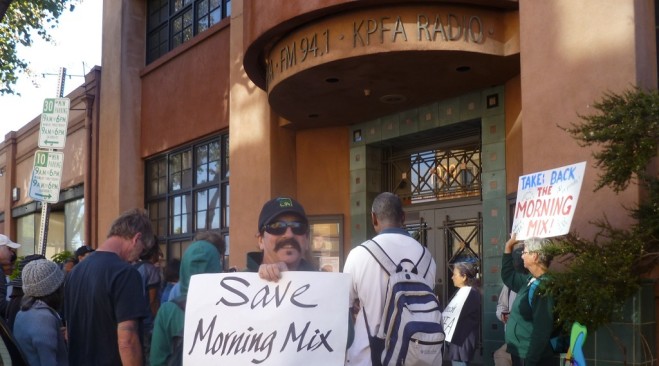
The most recent dispute is over the abrupt replacement of the locally-produced 8 a.m. show The Morning Mix with a radio program from LA called The Uprisingostensibly because the new show will generate more revenue during pledge drives. In response to being rescheduled and shortened, the hosts of The Morning Mix held protest rallies outside the KPFA building and took over the studio on May 26 to air their concerns.

According to Andrés Soto, one of the hosts of The Morning Mix‘s five rotating shows“I was really displeased that the morning mix has become a political football between rival factions…the morning mix, as an expression of authentic community voices, is what deserves to be heard.”

But, according to Richard Pirodsky, the Interim General Manager of the station, “The problem was that even though it had been on the air for three years, only one of the five Morning Mix shows was generating enough listenership and audience to even come close to justifying being in that golden hour.”

Supporters of The Morning Mix are organizing to attend the Community Advisory Board meeting in Oakland this Saturday, as well as hosting a “Save The Morning Mix” barbecue in Berkeley this Sunday, in hopes of pressuring the station to restore the show. While this disagreement and protest may not yet sound worthy of the “existential crisis” label, the story gets much deeper.

The radio station, founded by conscientious objector Lewis Hill in 1949, was the first of what would become the Pacifica Radio network: five stations across the country that are independently operated without any corporate sponsorship. While the accomplishments of this network are many, the predominantly listener-funded, locally-produced shows have struggled to contend with NPR’s corporately-underwritten programs, and with their own ideals of democratic, community-oriented radio.

In 2001, after 3 years of protests and lawsuits following an email leak, the Pacifica board signed a settlement that democratized the governance of the stations, allowing listeners to elect the members of their Local Station Board. Each LSB is comprised of 18 elected listeners and 6 elected staff members. These 24 “delegates” are tasked with forming the annual station budget, filling station management positions, and ensuring the mission of community radio. From these delegates, 4 “directors” are elected yearly to represent their station in the Pacifica National Board, which sets network policy from offices next door to KPFA.

While this settlement was intended to create a truly representative and listener-directed model of community radio, the reality has been more challenging. Chronicbudgetary problems (and their disputed “causes”), opposing visions for the future of the station, and abrasive implementation of management and board decisions (as in abruptly firing the former Executive Director Summer Reese, or canceling The Morning Mix), has led to regular confrontations among the various staff cliques, who at this point openly refer to themselves as “factions.”

At KPFA, the central rift is between the Support KPFA — United For Community Radio (UFCR) faction and the Save KPFA faction. UFCR is the more radical, community-oriented group, while Save KPFA is aligned with the views of management and directors, and, importantly, Dan Siegel, who has a long history with the network and, according to savekpfa.org, was a “representative on the Pacifica National Board until he stepped down in January to run for Mayor of Oakland.”

Many of those sympathetic to the UFCR faction accuse Dan Siegel and Save KPFA of bullying, ignoring legal conflicts of interest, and trying to take over the network in order to sell off the East Coast stations. On the other hand, Save KPFA has accused UFCR of union-bustingsabotage, and trying to take over the network in order to, well, just to take it over.

This is where the existential threat comes in. UFCR is afraid that the station is going to lose sight of its community-radio mission to represent diverse and underserved points of view, and that the historic Pacifica network will be dismantled in the process. On the other hand, Save KPFA is afraid that the governance of the station and the network are excessively democratic, to a point where compromise on the revenue vs. community issue is unattainable and that UFCR will lead Pacifica into bankruptcy.

As Richard Pirodsky, the IGM who made the decision to replaceThe Morning Mix, put it, “they have in some ways been so mission-driven in terms of trying to bring diverse programming that you can’t find elsewhere on the dial, almost to the exclusion of worrying about whether we can afford to continue to do it.”

And this is where the “Berserkeley” side of this situation comes in. Save KPFA currently has enough of a majority with the Pacifica national board to preempt democracy by firing who it wants to fire and cancelling the shows it wants to cancel, leaving UFCR no other options besides protest, occupation and litigation.

There seems little chance of this situation being peaceably resolved, and realistically, this feud poses the greatest threat to the future community radio, but at least we can savor the irony of Save KPFA’s decision to replace The Morning Mix with The Uprising.