
Underlying problems
Whenever there is a conflict, there is always an escalation in rhetoric, like when there was the inflammatory charge a few years ago that the Pacifica National Office was engaged in union busting. We should avoid getting caught up in the rhetoric and address the real problems and concerns.
One major area of friction is programming. It stands to reason that a trade union looking after the financial security of its members will prefer programming which appeals to a more affluent audience. But the mission of Pacifica is to be the commons of the airwaves, to represent a broader and more diverse community, to include marginalized and under-represented voices.
Programmers with established shows will understandably be protective of their airtime; however, Pacifica bylaws state that programming decisions and program evaluations should be done in a fair, collaborative and respectful manner (e.g. with a Program Council).
Another area of friction is the working relationship between paid and unpaid staff. Until 1996 both were represented by one “industrial” union. In 1996 this was changed to a “craft” union that no longer represented the unpaid staff. This created a class system resulting in an uneasy working relationship between the paid and unpaid staff.
Possible Solutions
So what to do with these conflicting needs and interests? How does a union look after the financial security of its members in a non-profit organization that relies on donations by listeners, does not make profits and must live within a balanced budget?
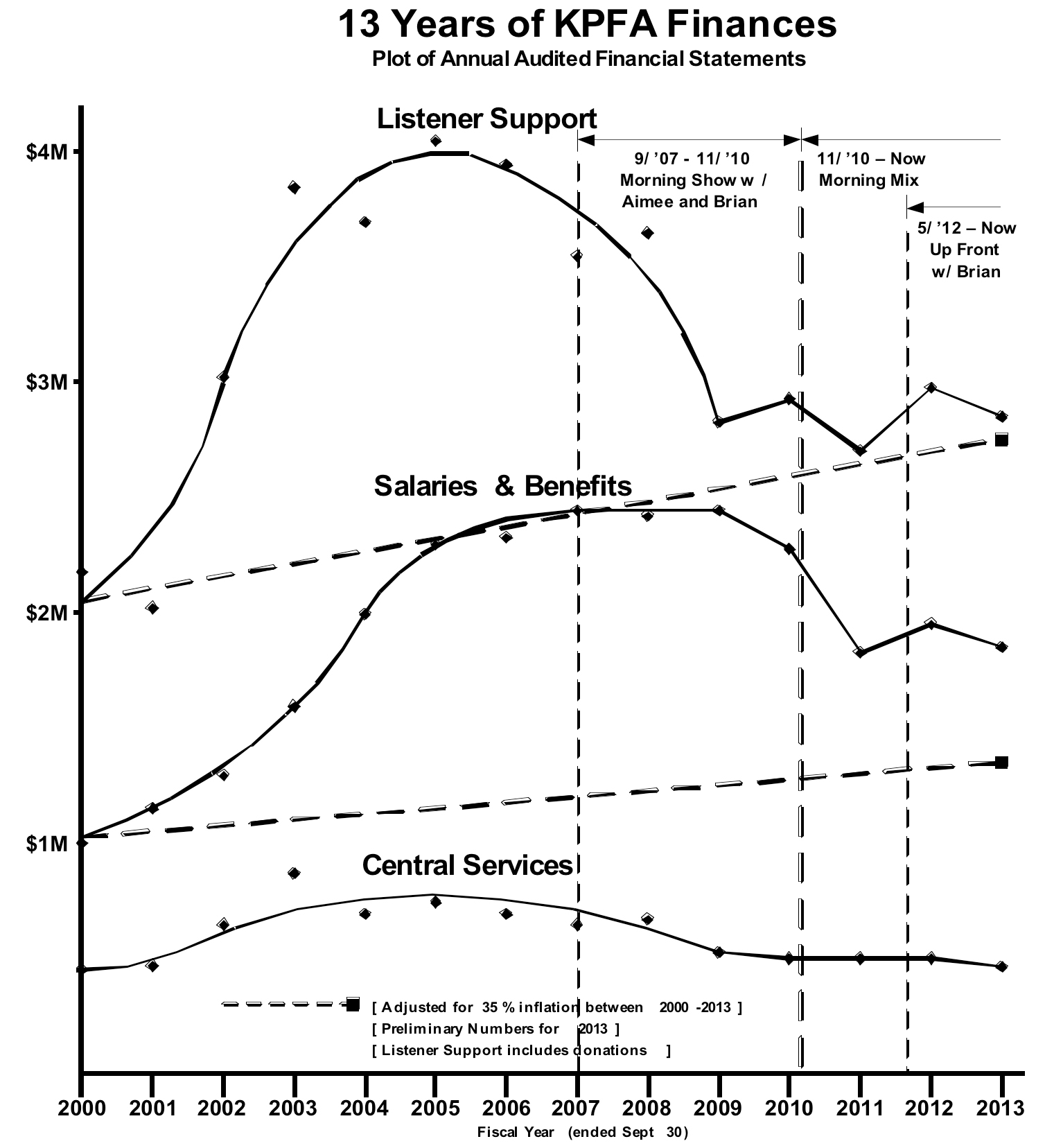
The primary task of the station should be to fulfill the mission of Pacifica. The management and union should carefully work out a staffing level that is sustainable over the economic ups and downs, and avoid the temptation to add more paid staff during the economic boom times as happened in 2001-2006.

Akio Tanaka
The painful trauma of layoffs in 2010 is a consequence of having more than doubled the payroll (125% increase) between 2001 and 2010.
A sustainable paid staffing level would help address the main source of tension. It could curtail the seemingly endless appeal for funds. It could put a stop to the unseemly practice of measuring the value of a program by the amount of money it brings in – a sad and ironic state of affairs.
It is important to note that KPFA relies on a large number of unpaid staff; the majority of the programming is done by the unpaid staff. At KPFA there simply is not enough money to pay all those who contribute to the station. Progressive organizations like KPFA should have one all inclusive union for everyone who works at the station, or have in place a system to treat all workers fairly and equally.
The “Proud to be Union” banner at the station is unnecessarily divisive and should be taken down. While the notion of workers’ rights resonates to all within the progressive community, it must be remembered that it is to respect and honor ALL labor.
It is time for all the staff, paid and unpaid, and for listeners to embrace the democratic victory that was won for us in legal and street battles of 1999-2001. It is time to stop dividing the station.
by Akio Tanaka 03-15-14
[KPFA LSB Member 2006-2012]