No Indictment for Darren Wilson? Why Not Preempt and Throw Open the Phones?

By Ann Garrison, KPFA Unpaid Staff Council Member and Reporter/Producer

KPFA listeners seemed confused and disappointed when the station failed to preempt programming and broadcast live after the St. Louis District Attorney’s announcement that the Grand Jury would not indict Officer Darren Wilson for killing Michael Brown.

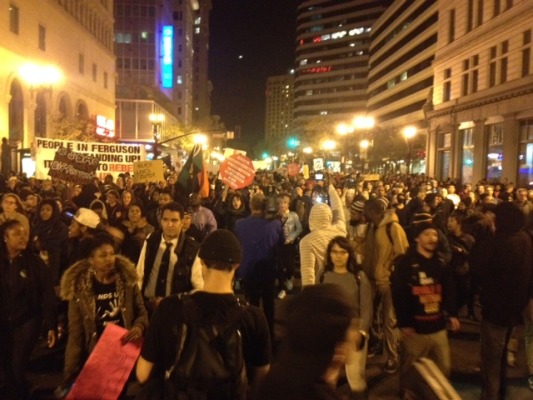
Downtown Oakland the night in question

Downtown Oakland after the announcement

I tuned into KPFA myself, right after watching the St. Louis District Attorney’s press conference on C-Span, and was surprised to hear the regularly scheduled programming, Africa Today, with Walter Turner without any Ferguson coverage.  I went back to switching between MSNBC’s outrage and Fox News’s celebration.

It later occurred to me that if Walter Turner’s show had been live, Walter would have been commenting on what had just happened, so the show must have been pre-recorded.  I also thought that, though I can’t claim to know Walter well, he most certainly would have understood if his pre-recorded show had been preempted for live broadcasting.

I didn’t otherwise have a strong opinion about what KPFA should have been doing right after the press conference. I just knew I wasn’t interested in what it was doing.  Women’s Magazine host Kate Raphael remarked later that she and a friend had been driving around, trying to figure out where a protest would be forming, and they were surprised when they weren’t able to tune into KPFA and find out.

That sounded right.  News of where protestors were gathering seems to be the minimum KPFA listeners should be able to expect.   Reporters or simply callers dialing in from the protests would have added value, and a video livestream like that arranged during the Block the Boat demonstrations would have been even better.

Former KPFA GM and WBAI PD Andrew Leslie Phillips nailed it, though, when he wrote, on a social media site, that “KPFA should have preempted and opened the phones.  It’s a no brainer.  It’s what radio does best.”

Of course.  People were emotional and/or in shock, even though very few had expected an indictment.  They would want to call in and hear others calling in and feel like KPFA was a community.  I myself turned to Facebook and Twitter for a sense of community, as I switched TV channels between MSNBC and Fox talking heads and livestreams from Ferguson, but I felt like something was missing: KPFA.  I would have liked to hear the phones thrown open and that would have been enough to assure that the location of protests gathering around the Bay would have been called in.

Andrew also wrote that, “Management are often intimidated by staff – but when program managers make intelligent, news-generated decisions, staff understand. It’s not about staff or unions, it’s about serving listeners. Preempting programs invigorates the air.  It’s almost always good radio.  And Pacifica should be out in front on this.”

He’s absolutely right.  Never mind that he’s on the Save KPFA side, I’m on the UCR side, or whatever  else.  Who cares?  He nailed it.  “KPFA should have preempted and opened the phones . . . it’s a no-brainer.   It’s what radio does best.”  I’ve always respected Andrew’s radio artistry and most always respected his programming judgment.

I don’t know why KPFA barely responded during the first days after the St. Louis Grand Jury decision and don’t care.   I just hope something that feels like community radio comes together next time, as it did after George Zimmerman’s acquittal, and during the Block the Boat for Gaza demonstrations at the Port of Oakland.  KPFA should feel proud to have played a role in the Block the Boat for Gaza organizing success that was reported by news outlets around the world, including Israel’s.

Welcome Back – KPFA Phone Room

Phone Room 1KPFA’s  fund drive phone room, where listener volunteers answer the phone to take pledges, is one of the only regularly scheduled events that brings KPFA listeners through the station’s doors. The phone room gives listeners the opportunity to meet one another, in the phone room and over the phone, and allows informal contact with KPFA staff.

During the past two fund drives, the switch to an automated system upset many listeners and staff, so it was a welcome relief when the phone room was reestablished beginning with the December 2014 fund drive.

During the pledge periods that were handled by the automated phone system, some KPFA hosts reported that listeners were unable to get through to pledge. Peter Gill, who has been a phone room volunteer since the station was located on Shattuck Avenue, wrote:

I have now heard I believe it is the fifth on-air host saying that they have been getting calls from people attempting to call and pledge over the phone that these people have been having trouble getting through. In all of the decades that I have been listening to KPFA I can’t remember ever hearing an on-air person say this before.

I thought that the rationale for switching from volunteer phone answerers to a call center was that calls were being missed by the phone volunteers, a problem which I as a phone volunteer never saw. What is going on here? Add to this the added cost of the call center and the whole thing makes no sense. I greatly enjoyed volunteering and it was a great way for those with not much money to become members.

Phone room 2Some staff and listeners also objected to using KPFA and KPFK listeners’ contributions to pay Comnet, the Oregon-based commercial call center, after it was revealed that its owner, Bruce Hough, works as a right-wing campaign consultant.

So, welcome back to the phone room and to all the loyal listener member volunteers who staff it.  May it be one of many things grounding KPFA in our local communities for many years to come.

By Ann Garrison

11-13-14

Letter From The Gray Panthers

images

Gray Panthers of San Francisco      2940 16th Street, Room 200-4, San Francisco CA 94103   415-552-8800       graypanther-sf@sonic.net


KPFA Radio      1929 Martin Luther King Jr. Way    Berkeley, CA 94704

Dear Quincy McCoy,

As long time supporters of KPFA, members of the San Francisco Gray  Panthers are writing to tell you of our disappointment in recent management decisions at KPFA.

Because our members have supported KPFA monetarily over the years, we are only too well aware of the financial struggles the station is facing.

That said, we are also long-time supporters of Flashpoints, and deplore the $25,000 cut proposed in the new budget.  Flashpoints is a public affairs show with reporters on the ground conducting live interviews, for which it has won multiple awards.  How can KPFA cut  Flashpoints and propose in the same budget *adding* an additional wire service at a cost comparable to the Flashpoints cuts.  It is deeply problematic that KPFA proposes using money taken from quality on-the-ground live investigative reporting such as Flashpoints,  and using it for an additional news wire that will result in more news reporting read verbatim from the service.

In addition, given the financial status of KPFA, we are  concerned that the budget is also proposing an additional $40,000 for an automatic back-up answering service to collect pledges during KPFA and KPFK fund drives.  We have learned that the company is headed by a Tea party member. Each call to donate to KPFA or KPFK routes 90 cents a minute to this company or $3-5 per call.

This corporate call center is owned by Bruce Hough, an Oregon Republican who runs Impact Marketing, a Tea Party advertising and fundraising business. His partner is rabid Tea Party Congressman Sal Esquivel, who traveled to Arizona to stand with Michelle Malkin, the Minutemen and others in support of Arizona’s anti-immigrant  SB 1070.  Hough and Esquivel also funded vicious attack ads against local Democratic candidate and military veteran Jeff Scroggin. The ads were so disgusting that two out of three local Republican County Commissioners refused to endorse the Tea Party candidate associated with Hough’s Impact Marketing.   Hough and Esquivel were also labeled “Rogues of the Week” by the Willamette Weekly for an unethical scam to charge gullible voters to email Congress. Hough and Esquivel also  house conservative political action committees at Impact Marketing giving hundreds of thousands of dollars to local and national Tea Party candidates.  This flies in the face of what we have come to love and support about the Pacifica mission.

Lastly, Gray Panthers is concerned that the recent hiring process for the new Program Director was flawed.  We understand that rules of Pacifica hiring policies were violated as follows:

Section 1:  Specifying the number of Local Station Board members that must be on the search sub-committee.

Section 3: Specifying placement of advertisements for positions and distribution of applications for positions.

Section 5: Specifying notice of meetings and their open meeting previsions.

Section 8: Specifying voting procedures in the committee.

Section 10: Specifying disclosure of the selection process, once completed.

Section 12: Specifying the Local Station Board’s oversight of the committee’s process.

As long-time listeners and supporters of KPFA, we feel that precious resources should be spent on furthering KPFA’s mission of community radio, and that decisions over critical personnel matters should be made in accordance with Pacifica policies. Please respond to us addressing our concerns.

San Francisco  Gray Panthers Board

Patricia Jackson, Convener

cc via email: KPFA Local Station Board, Pacifica National Board

kpfalsb@googlegroups.com

pnb@pacifica.org

Bringing Peace to KPFA

Aki GraphicBy Akio Tanaka
[KPFA LSB Member 2006-2012]

Article as flyer:  Peace to KPFA

Underlying problems

Whenever there is a conflict, there is always an escalation in rhetoric, like when there was the divisive and inflammatory charge a few years ago that the Pacifica National Office engaged in union busting. We should avoid getting caught up in the rhetoric and address the real problems and concerns.

One underlying problem is financial. The trauma of the layoffs in 2010 was the consequence of the station increasing the payroll by 140% between 2000 and 2009. Even with the cuts made in 2010, income has not kept up with the expenses.

One area of friction is programming. It stands to reason that a trade union looking after the financial security of its members will prefer programming which appeals to a more affluent audience. But the mission of Pacifica is to be the commons of the airwaves, to represent a broader and more diverse community, to include marginalized and under-represented voices. Read More

[Lew Hill, the founder of Pacifica, was a conscientious objector. One such program was the Morning Mix, which was a show begun in 2010 and produced by members of local activist community; however, in 2014 it was inexplicably replaced by a show produced in LA.]

Another area of friction is the working relationship between paid and unpaid staff. Originally, both were represented by one “industrial” union. In 1996, it was replaced by a “craft” union which only represented the paid staff. This created a class system resulting in an uneasy working relationship between the paid and the unpaid staff.

Possible Solutions

So what to do with these conflicting needs and interests? How does a union look after the financial security of its members in a non-profit organization that relies on donations by listeners, does not make profits and must live within a balanced budget?

The management and the union should work out a staffing level that is sustainable over the economic ups and downs, and avoid the temptation to add more paid staff during the economic boom times as happened in 2001-2006. Achieving a sustainable paid staffing level is a challenge, but it would help address the main source of tension. It could curtail the seemingly endless appeal for funds. It could put a stop to the unseemly practice of measuring the value of a program by the amount of money it brings in – a sad and ironic state of affairs.

The primary task of the station should be to fulfill the mission of Pacifica. We should bring back the locally produced show, the Morning Mix, during the morning “drive time.”

It is important to note that KPFA has always relied on a large number of volunteers who produce the majority of programming. At KPFA there simply is not enough money to pay all those who contribute to the station. Progressive organizations like KPFA should have one all inclusive union for everyone who works at the station. While the notion of workers’ rights resonates to all within the progressive community, it must be remembered that it is about respecting and honoring ALL workers.

Instead of taking sides, we as listeners should encourage the paid and unpaid staff to work together and help each other to produce the best in progressive radio. It is time for the staff, paid and unpaid, and for the listeners to embrace the democratic victory that was won in the legal and street battles of 1999-2001. It is time to stop dividing the station.

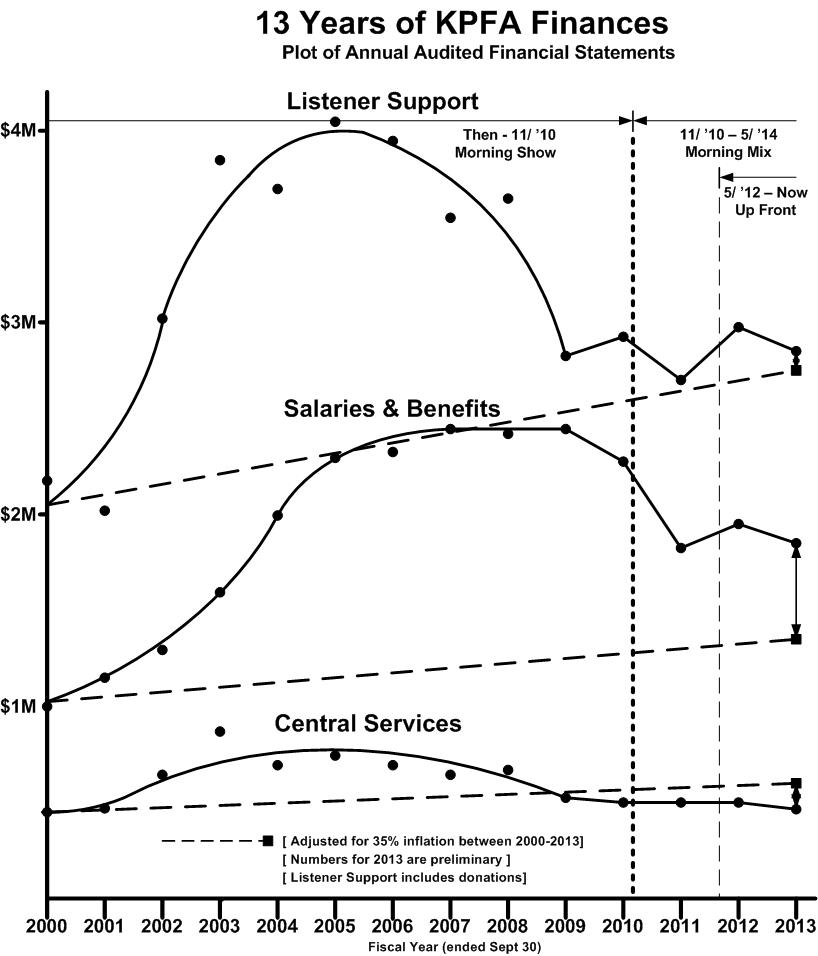
13 Years of KPFA Finances

1. Listener Support:  There has been a claim that cancellation of the Morning Show in fall of 2010 resulted in sharp decline in Listener Support.
The audited financials show that steep decline in Listener Support occurred between 2006 and 2010, before the change. (Adjusted for inflation, since 2010, Listener Support is back to the 2000 level, irrespective of the morning programming line-up.)

2. Salary and Benefits: Some have charged that Pacifica usurped local control and engaged in
union busting.
The audited financials show that between 2002 and 2006, under local control, the station added way too many people (the payroll more than doubled), and between 2006 and 2010, under local control, the station did not address the steep decline in Listener Support. By the fall of 2010, the station was in danger of insolvency, which is the only reason that the Pacifica National Office stepped in, to bring expenses in line with income. (Adjusted for inflation, even with the cuts that were made in 2010, Salaries and Benefits are still above the 2000 level.)

3. Central Services: There has been a claim that there was massive overspending at the Pacifica National Office. Central Services pay for network administrative services like FCC licenses, audit, insurance, legal, Pacifica archives, and national programming like Democracy Now! (Adjusted for inflation, since 2010, Central Services has been below the 2000 level.)

9-29-14

Listening: Just Peace: Radio Free Georgia Broadcast on Sub-Saharan Africa

2013 PNB Vice Chair Heather Gray hosts this discussion with Black Agenda Report editor Bruce Dixon and Pacifica reporter Ann Garrison on imperialism in East Africa, the legacy of genocide and massacre, propaganda and distortion and the Congo in a wide ranging hour-long conversation.

National Lawyers Guild Letter to KPFA On The Morning Mix

download (1)


REMOVAL OF MORNING MIX FROM DRIVE TIME PROGRAMMING

The recent removal of the Morning Mix radio program from the 8:00 AM time slot on KPFA has raised some concern at the San Francisco chapter of the National Lawyers Guild (“Guild”). We write this letter because KPFA and its free speech mission, are important to the Guild and to many activists that either work with, or are represented by, Guild members.

The Guild views KPFA not as simply another movement organization, but as a key part of the information commons. In that sense, KPFA is similar to a public utility — it is for the public benefit. KPFA policies on openness and actions regarding access to its airwaves affect all of us striving for a better world.

Like KPFA and Pacifica, the Guild was created with a particular mission: it was founded in 1937 as an alternative to the American Bar Association’s exclusionary practices and political orientation, and the Guild was the first integrated bar association. KPFA was launched in 1949, three years after pacifist Lew Hill created Pacifica. The aim of the station has always been to promote cultural diversity, to promote pluralistic cultural expression,  to contribute to a lasting understanding among diverse constituents, to maintain freedom of the press, and to create a forum for various viewpoints.

At KPFA’s core is the concept of pacifism or non-violence. Non-violence is often mistaken for being simply the absence of, or opposite of, violence. Instead nonviolence is a systematic framework of both conceptual principles and pragmatic strategies to reduce harm and promote positive peace at the personal, community, national and global levels. Contrary to popular belief, non-violence requires boldness and courage. Moreover, it is easy to fall astray from the path of non-violence in the pursuit of financial stability or in response to political pressure.

With this framework and history in mind, we raise our concerns about an uncomfortable pattern of events that have transpired at KPFA that appear to be the antithesis of non-violence. We do not list these concerns to cast blame, or to impose our set of values on another organization. We list these concerns because our collective silence could be perceived as approval or consent. We consider individuals and organizations on both sides of this debate as both friends and allies. It is in the spirit of a friend and ally that we speak about the recent decisions at KPFA, and seek to build trust through transparency.

The Morning Mix was unique within the KPFA lineup because it was hosted by a diverse group of community volunteers with programming important to community members. The Morning Mix often reported on local political movements that were under-reported elsewhere. One such issue is tar sand extraction and transportation by rail to refineries. Andres Soto, one of the hosts of the Morning Mix, and a Richmond resident and activist, often reported on this issue. He frequently reported on Chevron’s efforts to refine tar sands in Richmond which will have a direct impact on the people of Richmond and surrounding communities. Across the nation, we see a growing movement on this issue, and the Guild has recently received reports of brutal arrests of people who oppose tar sands. Instead of supporting this excellent reporting done by Andres Soto on this issue, KPFA has essentially silenced him by eliminating the prime time Morning Mix program. It is doubtful that the new paid host from LA will report on local efforts to oppose refining tar sands in the same way.

We could go through other hosts and programs on the Morning Mix, and discuss how each is connected to a local community and movement, however the point is that KPFA’s actions have actually decreased the diversity of speech on its airwaves.

As a community-based radio station dedicated to pluralistic expression, it would seem that KPFA would wish to avoid even the appearance of decreasing diversity, or of favoritism, or of bias. Gentrification of a neighborhood transforms it by displacing local residents, which in turn erases local character. Defenders of gentrification support the transformation, claiming that it increases public safety. Some at KPFA have described the removal of the Morning Mix as a ” move towards professionalism”. However we fear that “professionalism”, like “public safety” is pretext. The unqie character of the Morning Mix came from its local voices, accents, topics and perspectives. KPFA erased this local character with a single paid host out of LA.

Another reason put forth by by KPFA management is that the LA program will allegedly bring in more revenue. Although people can and do argue about interpretation of financial figures, the financial documents produced at the KPFA Local Station Board show that the Morning Mix was pulling is weight during fund drive. Thus, KPFA’s reliance on a specific interpretation of its financial figures, when there are other valid interpretations,  is a factor that creates the appearance of viewpoint bias. For example, the KPFA financial documents do not take into account the expenses incrred by having paid hosts. Thus, the financials purport to measure programs in terms of revenue generated, and disregard specific costs incurred by having paid hosts.

Moreover, and this point cannot be emphasized too much, KPFA can not and must not base all of its programming decisions on finance alone.

Although this letter was prompted by the removal of the Morning Mix, in the course of drafting this letter, we have learned of complaints that KPFA management has silenced specifically black programmers and/or failed to provide support for critical black programming or programming on critical local issues relevant to black communities. We are concerned that the removal of the Morning Mix, a show frequently hosted by black local hosts, is part of this pattern. We understand that KPFA is filling the Morning Mix time slot with a show hosted by a person of color, however the show is not produced locally, and does not have as close a connection to Bay Area black communities, and that features voices of black programmers, and not assume that programming by or for people of color generally will necessarily cover these issues.

KPFA, as part of its mission, must be ever vigilant of protecting diversity of viewpoints. Removal of the Morning Mix has narrowed the range of speech on its airwaves.

KPFA appears to promote radio programs that would prefer to talk about global economics, rather than race and the local displacement of black and immigrant families. It is an agenda that appears it would rather talk about gender discrimination in the boardroom, but not talk about the impact of gender, race and poverty on the young girls caught up in sex trafficking on Bay Area streets. It is an agenda that appears it would rather solve problems abroad, rather than those at home.

The Guild is an organization dedicated to human rights over property rights, and our collective conscious is touched when KPFA – a radio station dedicated to promoting diversity – consciously or unconsciously engages in viewpoint suppression. The allegations may be uncomfortable, however we in the Guild believe that it is through transparency and discussion of diverse viewpoints that this situation can be resolved.

In solidarity,

Sharon Adams, Vice President

National Lawyers Guild, Bay Area Chapter

August 12, 2014

NLG letter re Mix & KPFA