“Meet Candidates” Garden Party

Please follow and like us:


Please join us for our

UNITED FOR COMMUNITY RADIO

“MEET CANDIDATES”

GARDEN PARTY FUNDRAISER

SUNDAY, AUGUST 9th, 3 pm – 7 pm

GRASSROOTS HOUSE,
2022 BLAKE ST., BERKELEY

RESCUE KPFA!


9183179346_92a99e0c25_b

LEARN ABOUT 

our  LOCAL STATION

BOARD CAMPAIGN

AND HOW WE CAN HELP

LIBERATE MEDIA TOGETHER

Donation: $4 – $400 or more and everyone is welcome to bring food, beverages and music to share
 
UNITED FOR COMMUNITY RADIO CANDIDATES

for the 2015 KPFA LSB ELECTION

From: Flickr - nekonomania (6)

From: Flickr – nekonomania (6)

·       Don Macleay – 5 years working for the Sandinistas, 19-year school volunteer, Green Party activist, former union organizer and shop steward Oakland 
·       (G.) Mario Fernandez – recent SF State political psychology graduate, former Napa Community College Student Body President, former Occupy Oakland volunteer 
·       Janet Kobren – current LSB member, Pacifica National Board Director, PNB Secretary (Pacifica Foundation officer), 2010 Gaza Freedom Flotilla survivor 
·       Jeremy Miller – Idriss Stelley Foundation program director, San Francisco No-Taser Task Force member, host of Heterotopia on Mutiny Radio, independent journalist with S.F. Bayview newspaper
·       Marilla Arguelles – former President of home care workers’ chapter, SEIU, Local 616, editor of “Extracts from Pelican Bay”, former KPFA Labor Collective member
·       Scott Olsen – Board member, Iraq Veterans Against the War, survivor of police raid on Occupy

·       Sharon Adams – attorney; immediate past vice-president of the National Lawyers Guild, San Francisco Bay Area Chapter; was instrumental in getting Berkeley to refuse to hold people in Berkeley jails for civil ICE detentions.

T.M. Scruggs

T.M. Scruggs

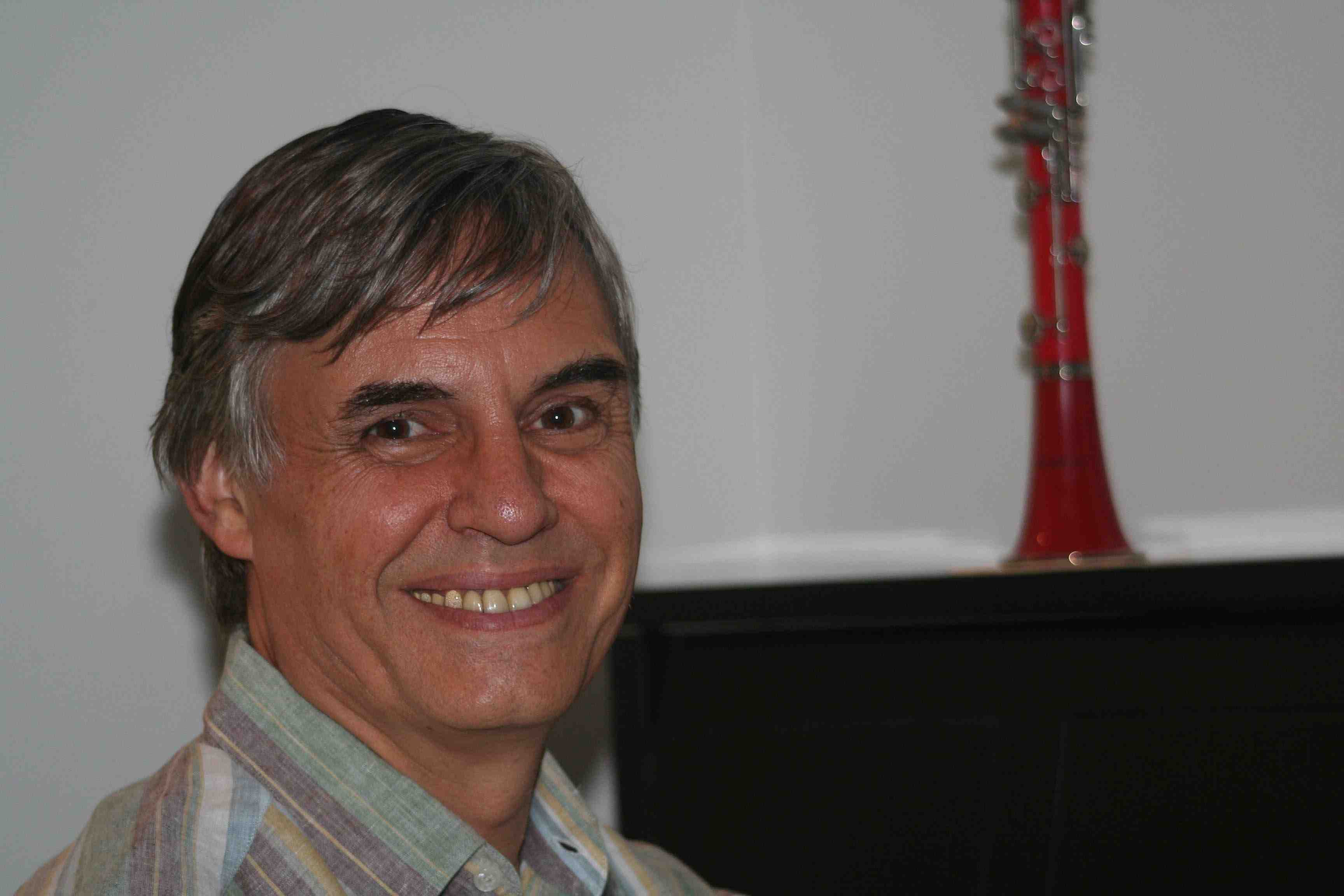
·       T. M. Scruggs – Executive Producer at TheRealNews.com; ethnomusicologist; Professor Emeritus, University of Iowa; volunteer for community radio stations in U.S., Nicaragua and Venezuela


·      Virginia Browning – current LSB member, health care researcher, down-winder, and longtime KPFA activist  

·       Anthony Fest (Staff) – Producer and host, KPFA’s “Weekend News.”  Producer of “Project Censored Show,”  “Afternoons with Andres Soto,” and  “Poor News Network.”

United For Community Radio also supports:

·       Richard Hart – former natural foods store owner, Berkeley progressive activist, longtime WBAI member
·        Tom Voorhees – early-on KPFA volunteer transmitter engineer; 2014 volunteer of the year, National Federation of Community Broadcasters
——————————-

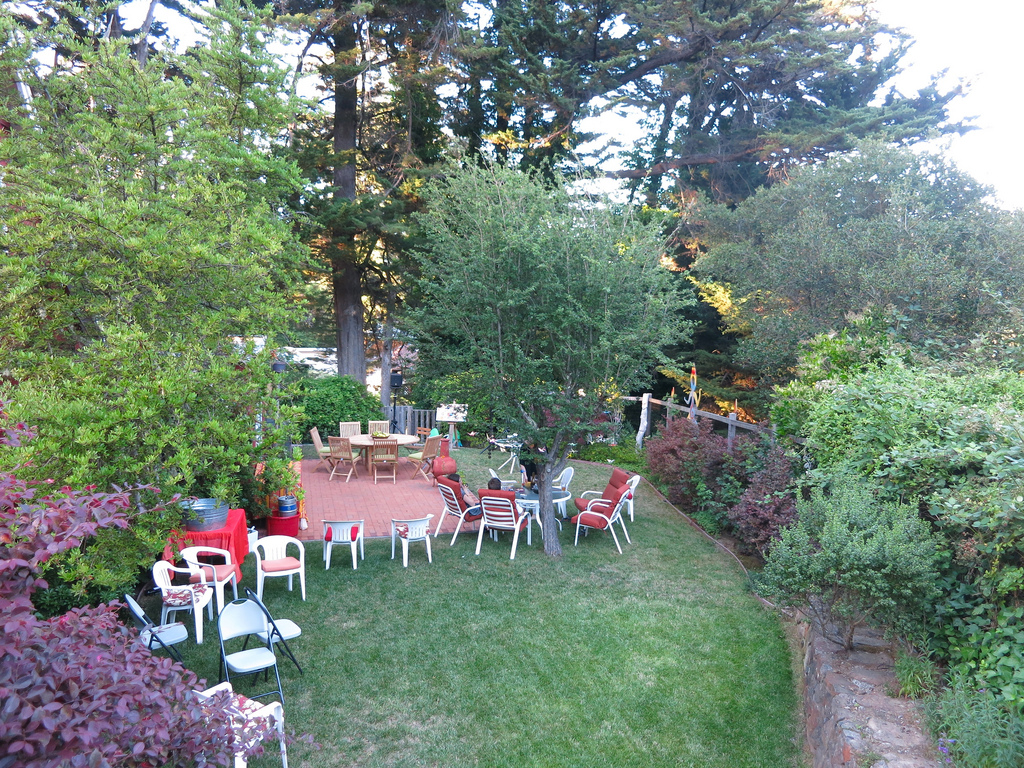
Garden party photo via photopin (license)

United for Community Radio Platform—2015

Please follow and like us:

unnamedKPFA and Pacifica are irreplaceable, strategic and transformative resources for amplifying the voices of millions who are overlooked, marginalized or silenced by corporate media in the face of police militarization, racism; and housing, health, water, economic, educational, and environmental depredation.   We forge a vital radio station and network by balancing often difficult news reports with programming that heals and facilitates human connections.

AS UCR MEMBERS and LSB REPRESENTATIVES WE WORK TO:

1.  Join the global media revolution by:

  • Updating KPFA technology so that KPFA reporters can generate news headlines and stories that challenge corporate media’s dominant narratives on the worldwide web.
  • Providing free real-time video streaming of demonstrations, rallies and other news events.  Offering low-cost access to recorded videos of lectures and other cultural activities.

2.  Promote a morning mix of community-sourced, local, daily, prime-time programing– making news together. This includes addressing attacks on immigrants, violence directed at people of color and discrimination based on race, nationality, gender, sexual orientation, age and disability.

Courtesy Incase, Flicker

Courtesy Incase, Flickr

3.  Re-establish a program council with decision making authority and broad-based listener and staff participation to evaluate existing programs and new proposals.

4.   Counter the influence of corporate political parties’ monopoly on opinion and assert a clear anti-war perspective. Honor the value of drama and humor  and include them in our programs.

5.  Improve access to resources and training for unpaid staff and provide all staff, paid and unpaid, the right to unionize.

6.  Provide a transparent and sustainable budget that aligns spending with actual income: Decrease the number of on air pledge drives.  No underwriting or advertising.

7.  Participate in a network-wide process to further democratize Pacifica/KPFA and improve financial stability.  We are committed to preserving the 5 stations, the national archives and affiliate services.

If you like this Platform, please support UCR’s campaign by making a donation:

Microphone photo license here

Lords & Ladies v.s. The Peasants at KPFA

Please follow and like us:

An allegory of the struggle at KPFA

by Daniel Borgström

Longtime KPFA listeners remember 1999 as the year of the Hijacking, the Lockout, and the massive response. Ten thousand people marched through the streets of Berkeley chanting “Take back KPFA!” and “Save Pacifica!”  And, as a matter of fact, KPFA and Pacifica Radio were rescued. The good guys really had won, or so it seemed at the time.  But the struggle has continued. Today, in 2015, the future of KPFA/Pacifica is more precarious than ever.
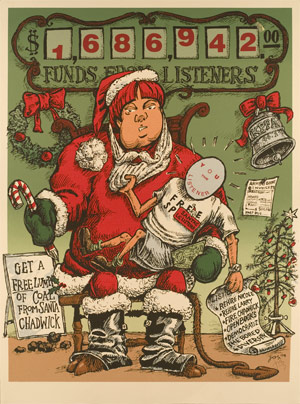
One of the many graphics from the 1999 struggle.  Santa holds the listeners like a baby.  Beside her right knee, a sign reads "Get a Free Lump of Coal from Santa Chadwick."  It refers to the then Pacifica Executive Director Lynn Chadwick.

One of the many graphics from the 1999 struggle. Santa holds the listeners like a baby. Beside her right knee, a sign reads “Get a Free Lump of Coal from Santa Chadwick.” It refers to the then Pacifica Executive Director Lynn Chadwick.

Sadly, this KPFA scenario is a common one in the affairs of humankind. I missed the French Revolution, but I imagine it went much like the one at KPFA.  The Bastille was stormed in a day, but what followed were meetings, meetings, and more meetings.  That’s probably true of all revolutions: there’s a dramatic moment, then months, years, even decades of intense, parliamentary struggle. Issues get complicated, seemingly arcane, and the struggle is vicious; people are sent to the guillotine.   Why the conflict? people ask, wondering why the former comrades can’t just be nice to each other and get along.
It also features a … read more
The KPFA upheaval of 1999 began, very much like the French Revolution, with a split among the power elite. Like Louis XVI of France, the headstrong monarch of KPFA/Pacifica quarreled with her courtiers, threw them out of the palace, locked the gate, and called in mercenary troops — rent-a-cops.  The disenfranchised nobility, losing their wits and acting out of sheer desperation, allied themselves with dissidents, appealed to the rabble, and called for mass demonstrations.

The response was huge, and thousands were suddenly marching in the streets.  To the astonishment of everyone, the rebels emerged victorious.  The intolerable monarch went into exile, leaving the kingdom to the triumphant revolutionaries — a motley assemblage of commoners, peasants and riffraff, together with nobility and bureaucrats from the old regime.  Everyone pledged eternal loyalty to the ideals of the revolution, the Mission Statement.
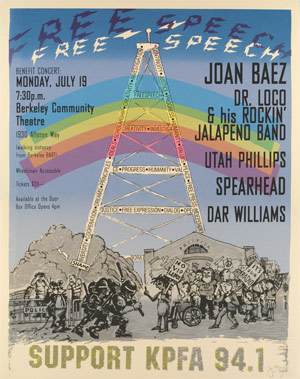
_DSC0181&175_free_speech_joAt first there was wild jubilation, dancing in the streets, and a huge amount of good feeling.  All the worthy people were dear sisters and brothers, in a splendid state of living happily ever after.  The bluebloods and bureaucrats from the old regime joined in the celebrations together with their low-class brethren, graciously tolerating the situation, putting a good face on it, and biding their time.

The trouble was that the ungracious mob expected to have a say in the running of the new regime.  So the lords and ladies were then faced with the daunting task of getting this horde of loud, smelly, cantankerous, meddlesome peasants to leave the castle, go back to tilling the lands, and give up their preposterous notions of involving themselves in governance.

That’s been the basic scenario in just about every revolution on record, and KPFA has been no exception to the pattern.  Major differences and animosities began to surface during the drafting of Pacifica’s new constitution, known as “The Bylaws.”  Courtiers and bureaucrats from the old regime tried to bend the new document to their liking, intending to preserve whatever they could of their former status and privileges; they did win major concessions.  Nevertheless, the dissidents stuck to a vision they’d been nurturing for many long years during the decade preceding 1999.  The traditional motto of “liberté, égalité, fraternité” was updated to include “democracy, transparency, accountability.”

The outcome beginning in 2002 was a radically new system of radio governance, a “listener democracy.”   Listener-members who donated $25 or more to the station became voters, choosing their representatives to sit on boards overseeing the KPFA station and the Pacifica radio network.  In radio governance, this was a revolutionary concept; however the Lords & Ladies found it absolutely revolting.

(The outraged bluebloods are the relatively small clique of gatekeepers who run the station; some have been there for over three decades, others are fairly new.  Most of the unpaid staff, who in fact produce most of the programming, are excluded from the ruling clique, as are some of the paid programmers.  They’re part of the peasantry.)

There was a time, the good old days, when peasants knew their place.  One can sympathize with the plight and anguish of the once proud KPFA aristocrats, courtiers, and bureaucrats, who found themselves sitting shoulder to shoulder with unwashed peasants who had the audacity to ask nosy questions, and worst of all, expect that the station live within its financial means.  Peasants can be so intolerably frugal; they want to know how the listeners’ money is being spent.

Money, and how it gets used, misused or just plain wasted, has been an ongoing issue.  Programming is another: should KPFA be the voice of progressive social movements?  Listener democracy itself is of course among the major controversies: should the board be elected by listeners, or appointed, and if appointed, appointed by whom?

I won’t say more about the issues here, or try to list them, as they’re discussed elsewhere in numerous articles.  What I do want to point out is that this struggle was going on long before the events of 1999, and it continues.  The basic issues have remained largely the same for the last 25 or 30 years.

In the French Revolution, as in so many others, the aristocrats (or some newly minted aristocrats) were soon back in power.  But does it really always have to turn out that way?  At KPFA the outlook is not optimistic.  Nevertheless, the peasants have somehow managed to hang in there for the sixteen years since 1999, struggling toward a different outcome.

Daniel Borgström is a descendent of European peasants who lives in Berkeley and listens to KPFA 94.1 FM.  You can find this article and more at Daniel’s blog.

Hands off Frank: Open letter to the KPFA Local Station Board

Please follow and like us:

To the KPFA Local Station Board (LSB):

I am appalled by Brian Edwards-Tiekert and Mal Burnstein’s insults to KPFA Apprenticeship Co-Director and LSB staff representative Frank Sterling during the board’s last meeting.

Frank-Sterling

Frank Sterling, right, on the air with the KPFA Apprentices’ “Full Circle” radio hour.

Frank is the heart and soul of KPFA at this moment in time. Not only because he is trying to lead the station, kicking and screaming, into the new Web-based media universe, but also because he donates so many hours to the Apprenticeship Program and engages with the KPFA community that is trying, against all odds, to stand up to perpetual war, climate catastrophe, and plutocracy’s fierce determination to own and control every last dollar and resource on the planet.

These “leave it all to the professional manager” and “the board is just there to fundraise” mantras are equally huge insults to KPFA’s listener community. Continue reading

Towards Improving Local Community News and Public Affairs

Please follow and like us:

(Submitted by listener-representative Andrea Prichett to the KPFA Local Station Board, 4-11-15   Developed by Carole Wolfey.  The board has agreed to take up this proposal at their next  meeting, Saturday, May 9, 11 am – 4 pm.   See below for a link to the audio of the board discussion thus far.)

The LSB asks that KPFA General Manager and staff work with community members to develop a coordinated station-wide plan for providing local news and public affairs programming in alignment with KPFAs mission to cover local events and topics with a depth, insight and broad signal range that no other station can do.

This plan may include exploration of possibilities to increase access to information from the community such as:

1.  Organize an electronic bulletin board to share and utilize news and public affairs information resources from the KPFA community, local organizations and the public.Community bulletin board


2.  Establish a list of people involved with social justice, political, economic and environmental issues from our local geographical areas who we can invite to contribute to local news and public affairs programs as citizen journalists.


3.   Expand recruitment and training of program interns for news and public affairs. Articulate requirements for becoming an intern and make these requirement broadly known and available on our website to attract people who are skilled and/or interested in contributing to programming.


4.   Develop and communicate a system for programmers to be able to receive and use recorded segments from community members for news and public affairs programs.


5.  Utilize Twitter, Facebook and live stream channels to get up to the minute information for news and public affairs programs.

Coordinate a station-wide system for providing local news
and public affairs programming

6.  Create daily programs or parts of programs that focus primarily on local community news and public affairs at predictable and regular times during the work week.phone to the microphone


7.  Develop a protocol that clarifies when/how to cover breaking news in our signal range and to pre-empt programming in significant and emergency situations.


8.  Expand use of video channel and live streaming channel to cover local news and public affairs and cultural events.


Communicate regularly with listeners and viewers
about local news and public affairs.

9.  Develop outreach materials to let people know about station coverage of local news and public affairs programs and feature it on the website, the video channel, Twitter and Facebook. Include information about all the station resources including KPFA, KPFB, KPFA video channel, KPFA Facebook, KPFA Twitter, KPFA on You Tube and kpfa.org with program archives.hand offering mic


10.  Post written local news and public affairs stories on the KPFA website so that they can be accessed through computer searches.


11.  Increase (through training and recruitment of volunteers) our capacity to provide responses to emails and calls that are received at the station.

—————————————

Here’s the audio of the Local Station Board’s initial discussion of this proposal as well as a discussion of policies and procedures for pre-emptions and special programming at KPFA.


KPFA, the PNB and “Local Control”

Please follow and like us:
LOCAL-CONTROl-PHOTOSHOP
by Ann Garrison

 I can’t always respond to developments within the Pacifica Radio Network at the time they occur, so this is a look back at one of this year’s most noteworthy Pacifica National Board (PNB) votes. On 02/12/2015, the PNB voted to give the Pacifica Foundation CFO authority over the business managers at all five Pacifica stations.

This has remained on my mind because of its glaring inconsistency with the longstanding “local control” platform of the SaveKPFA majority on the KPFA Local Station Board (LSB) and their PNB delegates. I have never seen a SaveKPFA explanation of how this could be compatible with the “local control” they hailed five months earlier with “Finally, local control at KPFA,” a 07/12/2014 post to the SaveKPFA blog. This vote put newly re-hired CFO Raul Salvador in a position to hire and fire and give orders to the business managers at all five stations from coast to coast.

Janet Kobren, who ran for the LSB with the United for Community Radio caucus, introduced the motion. The SaveKPFA caucus then joined her in voting for it after Brian Edwards-Tiekert, a SaveKPFA staff representative, introduced this substitute wording:

The hire and/or termination of any Business Manager shall require approval by the Chief Financial Officer (CFO).

The CFO shall also directly supervise all accounting functions performed by Business Managers and shall participate in all evaluations of Business Managers.

The CFO may seek PNB approval for the termination of a Business Manager whose unit manager is unwilling to terminate him/her at the CFO’s recommendation.

How could this be “local control”?


Local-Control-Button
Local control, the 2013 audit, and a million dollars in lost CPB funding

During Summer Reese’s tenure as IGM and GM, the accounting staff at the PNO charged that the 2013 audit could not be completed in 2014 unless KPFA’s Business Manager Maria Negret agreed to open KPFA’s books for the PNO’s lead accountant Maria Gaite. This audit had to be completed in order for Pacifica to receive the Corporation for Public Broadcasting (CPB)  funds that it ultimately did not receive in 2014.

At one point I became so exasperated by the back and forth about this that I wrote to ask former KPFA General Manager Richard Pirodsky what the real problem was, and this was his e-mailed response:

“That the reconciliations should have been done long ago is the start of the problem. But it has been overcome at other stations. (Maria G. and Joyce had to do all of KPFK’s work, and work at KPFT, WPFW, and WBAI had to be re-done. All this delayed the entire process.) The holdup at KPFA came from the Marias (G. & N.), [Maria Gaite at the Pacifica National Office and Maria Negret at KPFA], not being able to work together. Maria G. wanted copies of all necessary documents. Maria N. wanted Maria G. to come over to the KPFA business office and work with her. She offered access to the original documents and Maria G. (or a chosen PNO staffer) was free to make copies of any documents that needed to be taken back to the PNO. But Maria N. and Maria G. just don’t get along and don’t seem to agree on much. As with so many aspects of Pacifica, personality conflicts preclude even the discussion of compromise or cooperation.”

I have two responses to that message:

1)  Richard Pirodsky was KPFA’s General Manager at the time. This PNB resolution centralizing control of Pacifica’s finances in the national office had not yet been passed, so he was at that time Maria Negret’s direct supervisor. He was the local manager in local control, as the SaveKPFA caucus seemed to advocate, and a million dollars is a lot to lose over a “personality conflict between the two Marias.” Didn’t he feel compelled to tell KPFA’s Maria Negret that he expected her to cooperate with the national office to get the audit done, as all four other stations’ business managers had?

Apparently not, and now, despite the loss of a million dollars in CPB funding in the name of local control, KPFA’s local manager has even less local control than before.

2)  What could have been the risk in releasing KPFA’s books to the Pacifica National Office for the audit, as every other station in the network had?  And why, after the current Board majority ousted Executive Director Summer Reese and rehired CFO Raul Salvador, was the PNB majority, and more particularly the SaveKPFA caucus, so eager to throw “local control” out the window?  The only logical conclusion I can come to is that “local control” was a useful mantra only until the SaveKPFA caucus and its allies were able to put Raul Salvador back in charge of Pacifica’s finances at the national office.

If they can explain this otherwise, I’ll do my best to listen with an open mind.

Ann Garrison is an independent journalist, a contributor to the KPFA Evening News and a member of KPFA’s elected UPSO Council.